
A Practical Guide To Understanding Sports Odds And Decision-Making
Introduction - Why Most Bettors Lose Before the First Ball
If you’ve ever backed a losing side and felt like the house always wins, you’re not wrong – but you’re also not powerless.
In fact, the problem isn’t luck. It’s the approach.
Cricket offers world-class players, fast-changing conditions and a near-endless calendar of matches. That’s exactly what makes it dangerous for the unprepared – and why learning how to bet on cricket the right way matters.
Most bettors treat it like entertainment too – a quick thrill over lunch, a flutter on the big-name franchise. The pros treat it like a calculated game of probabilities, psychology, and discipline. They know every market has a story, every price has intent, and every decision either compounds profit or drains it.
That’s the difference between gambling and smart betting – and this playbook exists to help you make that shift.
We’ve seen every kind of bettor: the dreamers chasing a five-leg accumulator bet on a busy match weekend, the spreadsheet wizards tracking every powerplay, and the disciplined few who quietly turn small stakes into consistent returns.
The irony? The edge that separates winners from losers isn’t secret data or insider tips – it’s the ability to think before you bet.
When you learn to understand value, manage your bankroll, and control your emotions, you stop betting for fun and start betting with purpose.
That’s when the game changes.
This cricket betting guide is your blueprint for that transformation – built around the rules and rhythm of the game.
In the pages ahead, alongside practical cricket prediction tips, you’ll learn:
- – How to read odds like a language – and spot where the bookies get markets wrong.
- – How to manage your money across an entire season like an investor, not a gambler.
- – How the powerplay, the playoff format and the venue change the numbers.
- – And most importantly, how to develop a mindset that wins before the first ball is even bowled.
Unlike most cricket betting tips, this guide won’t promise “guaranteed wins” – because they don’t exist. What you’ll find is far more valuable: the system and self-control that the sharpest bettors use to stay ahead in the only game that matters – the long one.
So grab your notebook, open your mind, and get ready.
Because luck fades. Strategy doesn’t.
Chapter 1 – Understanding the Odds: The Language of Winning
Odds are the alphabet of betting.
If you don’t speak the language, you’re not betting – you’re guessing, and no list of cricket prediction tips can fix that.
Most new bettors treat a cricket match prediction as a question of outcome (“Will my team win?”). Smart bettors focus on the price – because the odds are the price. They tell you what the market believes will happen and, more importantly, what the bookmaker wants you to believe.
1. What Odds Really Mean
Odds represent probability dressed as profit. They show how much you stand to win and what the bookmaker thinks your chances are.
- – Decimal Odds (India, Europe, Australia) – 2.00 means you’ll get ₹2 back for every ₹1 staked, including your stake.
- – Fractional Odds (Traditional UK) – 1/1 means even money; 5/2 means you’ll win ₹5 for every ₹2 staked.
- – American Odds (US Market) – +100 is even money; +200 means a ₹100 stake returns ₹200 profit; −200 means you must stake ₹200 to win ₹100.
To find the implied probability, simply flip the odds:
Implied Probability = 1 ÷ Decimal Odds
Example: 2.00 → 1 ÷ 2 = 0.50 → 50% chance
2. The Hidden Margin – How Bookmakers Make Money
Bookmakers rarely offer true probability; they build in a margin (also called the overround) to ensure profit whatever happens. Take an evenly matched T20 game as an example (illustrative prices only):
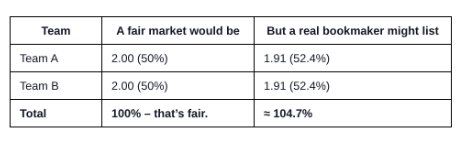
That extra 4.7% is the bookmaker’s edge – the silent tax on every bet.
Definition: What does ‘Edge’ mean? Your edge is your advantage over the bookmaker – the small statistical gap between the true probability of an outcome and the odds being offered. Every profitable bettor’s goal is to find and protect that edge.
Smart bettors aim to find mispriced markets, where the implied chance is lower than reality – that’s where value hides.
3. Why Understanding Odds Wins Before the Toss
Learning how to bet on cricket starts here: when you look at a price, don’t just ask, “Who’ll win?” – ask “Is this price fair?”
Because betting isn’t about predicting outcomes; it’s about spotting bad maths! If your calculated chance of success is higher than the odds imply, you’ve found positive expected value (EV) – the foundation of long-term profit.
Think like an investor:
- – You wouldn’t buy a stock at any price – you’d wait for undervaluation.
- – The same applies here: every odds line is a stock price in a constantly moving market.
4. Quick Reference Chart – Understanding Odds At A Glance
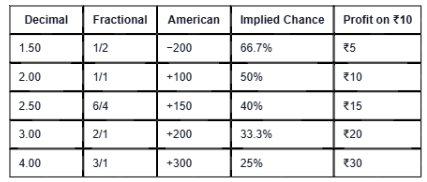
Pro Tip: “Odds aren’t predictions; they’re invitations. The bookmaker is offering you a price – your job is to decide if it’s worth taking.” Once you learn to see odds this way, you stop betting on emotion and start betting on mathematics.
Chapter 2 – The Concept of Value: Spotting Mispriced Markets
Every successful bettor has one obsession: value.
It’s the single word that separates those who bet for entertainment from those who bet for profit.
In simple terms, value means getting better odds than you should – when the bookmaker’s price underestimates the true chance of something happening.
You might not win every bet (no one does), but if you consistently bet where the odds are in your favour, you’ll win over time. Across a full cricket season, that’s the difference between a lucky week and a sound process.
That’s the core truth professional bettors live by:
It’s not about winning every bet – it’s about winning the right bets.
1. What “Value” Really Means
Take the coin toss before a match – “heads” or “tails”. It’s a genuine 50/50, so fair odds would be 2.00 (even money).
But imagine a bookmaker offers 2.20 on “heads”. That’s a 45.5% implied probability – meaning the bookmaker thinks it’s less likely than it really is. That’s a value bet.
You won’t win every toss, but if you keep getting paid more than the true odds suggest, the maths will eventually stack in your favour. That, in one line, is how to bet on cricket profitably.

2. How to Calculate Expected Value (EV)
You don’t need a maths degree – just a formula and a calculator.
Expected Value (EV) = (Probability of Winning × Profit per Bet) − (Probability of Losing × Stake)
Example:
- – You bet ₹10 at odds of 2.20.
- – You estimate a 50% real chance of winning.
EV = (0.50 × ₹12 profit) − (0.50 × ₹10 loss)
EV = ₹6 − ₹5 = +₹1 expected profit per bet
Over hundreds of similar bets, that ₹1 edge compounds – that’s what value betting is all about.
Pro Insight: “Winning bettors don’t chase outcomes – they chase percentages.”
3. Where Value Hides in Cricket Markets
Bookmakers price odds based on data, trends, and public behaviour – and the last one is your opportunity. Here’s where value often appears:
- – Brand Bias: Fans overbet famous franchises and last season’s finalists. Heavy public money on the defending champions or the biggest-name sides can push their opponents’ prices longer than they should be.
- – Team-News Timing: XIs land at the toss, and one star player in or out can change a side dramatically. Prices set before then can lag a late change.
- – Venue Totals: Runs and sixes lines built on league-wide averages can miss ground-specific factors – a small ground with short boundaries can play very differently from a big stadium with long ones.
- – Overreactions: One 200-plus total or one collapse skews public sentiment – not the actual probabilities.
Your job is to think objectively when others bet emotionally.
4. Building a Value Mindset
- – Forget Certainty: You’re playing probabilities, not predictions.
- – Track Everything: Keep records – stake, odds, result, expected edge.
- – Be Patient: True value betting plays out over dozens of wagers, not one weekend of matches.
- – Stay Disciplined: Don’t bet because you’re bored; bet because the numbers say so.
When you focus on process instead of outcome, you start thinking like a professional.
5. Checklist: How to Test a Cricket Bet for Value
Before placing your next bet, ask yourself:
- – Have I checked the true probability (form, venue, conditions, data)?
- – Are my odds higher than the implied chance?
- – Is the price drifting or shortening – and why? (Late XI news? An overseas player missing?)
- – Does my research back the edge?
- – Would I still place this bet if it wasn’t my favourite team?
If you can tick those five boxes, you’re not guessing – you’re investing.
Cricket Special: The Liquidity Factor – Why Smaller Markets Can Lag
Smaller markets – women’s cricket, domestic competitions and associate-nation fixtures – typically attract less betting volume than marquee internationals and the biggest T20 leagues. With less money moving the price, lines can be slower to react to team news and form – and that’s where prepared bettors find value.
The flip side: margins can be wider, and prices can jump on small amounts of money. Always compare across books, and never assume a thin market is a mispriced one. The disciplined move: let your research – not the price movement – tell you where the value is.
6. Key Takeaway
Value is the heartbeat of smart betting – and of any cricket betting tips worth following. Odds tell you what the bookmaker thinks will happen. Value tells you when they’ve got it wrong.
The sooner you master that distinction, the sooner you stop gambling – and start playing the bookmaker’s game against them.
Value isn’t about luck. It’s about logic repeated consistently.
Chapter 3 – Bankroll Management: Your Money = Your Weapon
If odds are the language of betting, bankroll management is the grammar that holds it together.
Without it, even the smartest bettor following the sharpest cricket prediction tips will eventually lose.
Think of your bankroll as your ammunition. Your job isn’t to fire wildly – it’s to make every shot count. And a packed cricket calendar – T20 leagues, bilateral series and global tournaments, often overlapping – gives you plenty of chances to fire wildly.
When you manage your money with structure, you transform betting from emotional entertainment into mathematical consistency. You may not win every battle, but you’ll stay in the war long enough to profit from your edge.
1. What Your Bankroll Actually Is
Your bankroll is the total amount of money you’ve set aside purely for betting – not rent money, not grocery money, not a spontaneous weekend flutter.
It’s your operating capital.
This separation matters. When you mentally and financially isolate your bankroll, every decision becomes rational, not emotional.
Pro Insight: “If your bankroll lives in your main bank account, your discipline doesn’t stand a chance!”
2. The Unit System – Small Stakes, Big Control
Professional bettors never stake randomly – and if you’re learning how to bet on cricket, neither should you. They use units – a consistent percentage of their bankroll per bet.
- – Common size: 1–2% per bet.
- – Example: ₹1,000 bankroll → ₹10–₹20 per bet.
That may sound small, but that’s the point. The goal isn’t to win big once; it’s to never go broke while you build consistent returns.
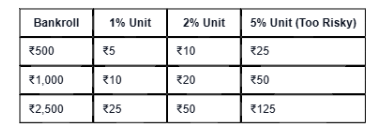
The lower your variance (ups and downs), the longer you stay in the game.
3. Flat vs Variable Betting
There are two main staking approaches – and knowing which fits your style can make or break your success.
Flat Betting (Recommended for Beginners): Stake the same unit size every time, regardless of confidence.
- – Easy to track
- – Reduces emotional swings
- – Perfect for testing your strategy
Variable Betting (Advanced): Stake slightly more when your edge is bigger (e.g., 3% instead of 1%).
- – Warning: Requires data-driven confidence, not gut feeling
- – Warning: Easy to overestimate your edge
Remember: Confidence doesn’t equal probability. Numbers do.
4. The Psychology of Losing – and Why It Destroys Most Bankrolls
Every bettor loses. The pros just lose correctly!
The average punter chases losses – doubling stakes to win back what they’ve lost. It’s a natural emotional response, but a mathematical disaster.
Example (a double-header match day):
- – Lose ₹50 on the afternoon game → stake ₹100 on the evening game to recover → lose again → now down ₹150. In a few hours, your “small bet” has turned into a bankroll meltdown.
Instead, treat every loss as data. Log the bet, analyse the reasoning, and move on. One bad night doesn’t define your edge – poor discipline does.
5. Tracking Your Bets – Turning Chaos into Clarity
A simple bet tracker is one of the most powerful tools in your arsenal. Track:
- – Stake
- – Odds
- – Market (match winner, innings runs, top batter, sixes)
- – Venue & conditions
- – Result
- – Profit/Loss
- – Notes (why you placed it, what you learned)
Over a full season, patterns emerge fast: you’ll see which venues, markets and odds ranges deliver your best results. That’s your data-driven edge – not a hunch, but proof.
6. How to Scale Safely
As your bankroll grows, so should your stake – but only in proportion. If you start with ₹1,000 and double to ₹2,000, your 1% stake becomes ₹20 instead of ₹10. You’re not betting “more,” you’re maintaining structure.
That’s how compounding works: discipline + time = exponential growth.
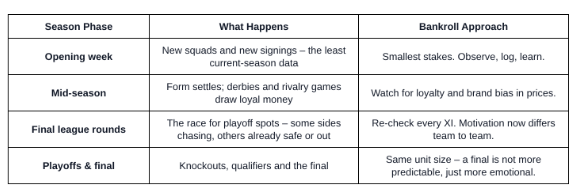
7. Pacing Your Bankroll Across a Season
A typical T20 league packs 60 or more matches into a few weeks, often with double-headers along the way. If you staked 2 units on every game of a 60-match season, you’d put 120 units – more than your entire 1%-unit bankroll – into play. Selectivity is bankroll management.
8. Key Takeaway
Bankroll management is the least glamorous chapter of any cricket betting guide – but it’s what keeps the lights on. Every successful bettor knows this truth:
You don’t win because you hit big. You win because you never go broke.
Treat your bankroll like a business fund, not pocket change. Protect it, respect it, and let it grow with patience.
Chapter 4 – Bet Types & Strategies: Building Your Betting Toolkit
Now that you understand odds, value, and bankroll management, it’s time to put those tools to work.
Every professional bettor knows that the smartest cricket betting strategy isn’t the one with the highest payout – it’s the one that fits the game, the odds, and your bankroll.
There’s no single way to bet smartly. There are systems, structures, and strategies – and this chapter of the cricket betting guide will show you how to use them, including the T20 cricket rules that reshape the markets: powerplay length, tactical substitutes and playoff formats.
1. The Core Bet Types (and When to Use Each)
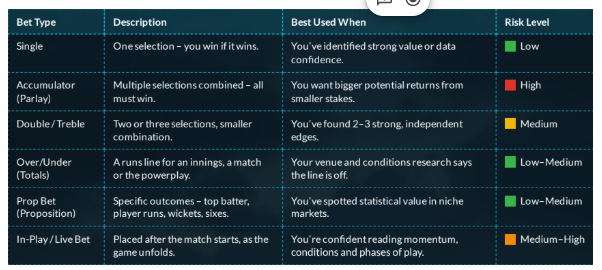
Every market behaves differently – your edge lies in knowing which type fits the moment.
2. Singles: The Professional’s Bet of Choice
Ask any seasoned bettor which bet type they rely on – and they’ll say singles.
Why? Because singles give you control, transparency, and the cleanest reflection of your edge.
When you stack bets into accumulators, your margin for error grows exponentially. For example, four cricket selections each at 1.90 odds:
1.90⁴ ≈ 13.0 combined odds. Miss one – and it’s gone.
And remember the margin from Chapter 1: in an accumulated bet, the bookmaker’s edge is baked into every leg and multiplies along with your odds.
That’s why the pros go solo. Fewer variables. More data. More precision.
Pro Insight: “Recreational bettors chase excitement. Smart bettors choose efficiency.”
3. Accumulators: The Tempting Trap (and How to Use Them Smartly)
Accumulators (or parlays) are fun, flashy, and high-payout – but statistically brutal. Bookmakers love them because the overround compounds with each leg. A “one bet on every match this weekend” accumulated bet is exactly the kind of fun bet that drains bankrolls.
However, used strategically, accumulated bet can have their place:
- – Limit them to 2–3 strong selections max.
- – Never use them emotionally (“it’s a big match day, why not?”).
- – Only include value picks you’d back as singles anyway.
If every leg has a true edge, your combined return compounds your advantage, not just your risk.
Pro Tip: “Treat accumulators like spice – a little adds flavour, too much ruins the dish.”
4. Prop & Niche Bets: The Hidden Goldmine
Mainstream markets (match winner, match runs) are heavily priced by algorithms and public volume – meaning value is harder to find. But top batter, player runs, wickets, sixes and powerplay totals are often under-analysed – which is why a well-researched cricket top batter prediction can carry real value. That’s where your research pays off:
- – Use stats to find consistent patterns by venue and phase of the innings.
- – Identify players who consistently score in the powerplay, clear the rope, or take death-over wickets.
- – Check each competition’s powerplay length – most T20s use 6 overs and ODIs use 10, but some leagues use shorter or split powerplays. Don’t port powerplay numbers from one competition to another without adjusting.
Small market inefficiencies = real opportunity.
5. In-Play Betting: Where Skill Meets Speed
Live betting is fast, emotional, and dangerous – unless you have structure. The edge here – and the core of most good in-play cricket betting tips – comes from watching what the algorithm can’t see:
- – A team scoring quickly in the powerplay but losing early wickets.
- – A captain saving a premium bowler for the death overs – the run rate can change sharply when they return.
- – A batter timing the ball well but not yet finding the boundary.
- – Day starts versus night games under lights, evening dew, rain interruptions and DLS-adjusted targets.
Bookmakers adjust odds automatically – but always after the fact. If you read momentum correctly, you’re ahead of the curve.
Pro Tip (and Golden Rule!): Never chase losses through live bets. Only play in-play if you have visual context and calm decision-making.
Cricket Special: League Rules That Move the Market
Generic T20 models don’t always capture each T20 league’s quirks. Know each competition’s rules cold – they change how innings unfold, which players matter, and which lines can be mispriced.
The 20-Over Innings, Phase by Phase
- – Overs 1–6: Powerplay in most T20 leagues – fielding restrictions, a new ball and fast scoring.
- – Overs 7–15: Middle overs – spin, strike rotation and wicket-taking.
- – Overs 16–20: Death overs – boundaries and wickets both spike.
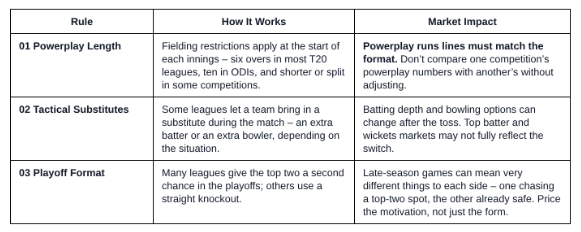
Research Checklist
- – Is either side missing an international star?
- – Who bowls the death overs?
- – Can a tactical-substitute rule change either XI mid-match?
- – Is the powerplay line built for this competition’s format?
- – Do totals lines account for the venue’s boundaries?
- – What’s at stake on the points table for each side?
The toss is a 50/50, and no amount of research changes that.
6. Simple Starter Strategy: The 1–2–3 Framework
For beginners still learning how to bet on cricket, start structured:
- – 1 unit per single (value-based bet)
- – 2 units max total exposure per match day
- – 3 rules before every bet
The three rules:
- – Is there data backing it?
- – Is the price fair?
- – Can I explain it in one sentence?
If not, skip it. On a double-header day, the two-unit cap covers both games.
7. The Cricket Market Map – What to Research for Each Bet
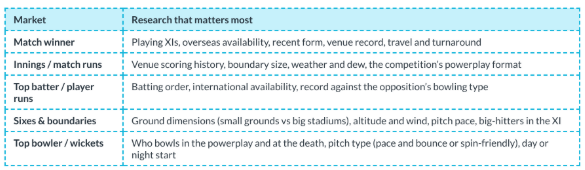
8. Key Takeaway
There are a hundred ways to bet, but only one mindset that matters: strategic discipline. Whether you’re betting one match or a whole season, this cricket betting guide will help you to identify value, stake rationally, and choose the right structure for your edge.
Betting smart isn’t about betting often. It’s about knowing when to strike and when to stand down.
Chapter 5 – Analysis & Research: The Edge Comes From Insight
Every bet you place is a decision based on information.
The difference between a casual bettor and a profitable one isn’t luck – it’s how they interpret that information.
In the same way investors study charts before buying a stock, successful bettors study data before placing a stake. In cricket betting, that means knowing the venue, the conditions, the XI and the rules as well as the form guide.
They understand one truth: the odds tell a story – but the stats reveal the truth.
1. Why Research Beats Gut Feeling
Gut instincts make great fans – but terrible bettors. Bookmakers price markets using advanced algorithms, real-time team news, and betting volume. The only way to compete is to bring your own research to the table. Ask yourself before every wager:
“What do I know that the market might be overlooking?”
When you can answer that question, you’re betting with insight, not with emotion.
2. The Core Data Points Every Smart Bettor Tracks
Our team looks at five data pillars before assessing any cricket wager:
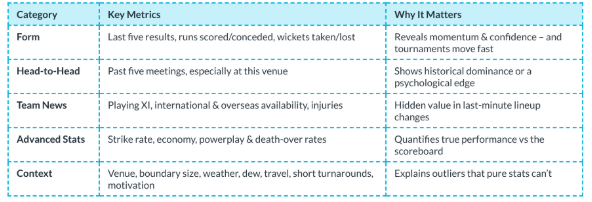
3. Where to Find Reliable Information
Avoid social-media hype – it’s noisy and emotional. Use trusted, data-driven sources such as:
- ESPNcricinfo: Statsguru, scorecards, venue records, team news
- Cricbuzz: Live scores, playing XIs, news
- Official board, league and team channels: squads, toss updates, team news
- Local weather services: venue forecasts, including rain risk and humidity
- Odds comparison / bookmaker market pages: price movement and drift
Combine two or three sources for each bet. One data point is trivia – three make a pattern. That’s the difference between solid cricket prediction tips and guesswork.
Pro Tip: Track your own shortlists using a spreadsheet or app. Consistency turns research into intuition.
Cricket Special: Venue Research Guide
Boundary sizes, pitch types, start times and climate change from ground to ground and country to country. Use this as your starting checklist – then confirm with current data before every match.
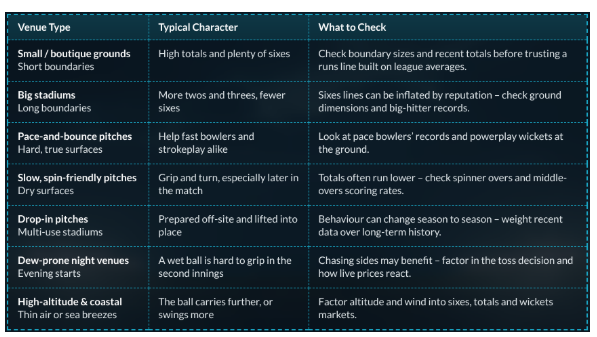
Day v Night: Many tournaments mix afternoon and evening starts. A day game and a night game at the same ground can play very differently – heat and a drier pitch by day, cooler air and possible dew under lights. Log the start time with every bet so your records can show the difference.
Venue character shifts from season to season – pitches, weather and boundary rope placement all vary. Treat these notes as questions to answer, not answers to rely on.
4. Spotting Mispriced Markets Through Research
The best bettors aren’t predicting the future – they’re identifying when the market’s current price is wrong. Cricket betting examples:
- – A key overseas batter or bowler is unavailable, but the market hasn’t fully adjusted.
- – A star international returns to (or is rested from) the XI, and the top-batter market still reflects last week’s side.
- – A team’s recent run rate or wicket-taking form has improved, but prices still reflect its reputation.
- – Travel across time zones or a short turnaround isn’t reflected in the odds.
By acting before the crowd adjusts, you’re locking in pre-market value.
Value Alert: “Information delay” is a bettor’s best friend – react faster than the bookmaker’s algorithm, but only on information you’ve confirmed from a reliable source.
5. Building Your Pre-Match Checklist
Before you hit “place bet,” tick these off:
- – Have I checked the playing XI and international & overseas availability?
- – Do the stats support the form I’m betting on?
- – Are the odds fair compared to the implied probabilities?
- – Have I considered the venue, weather, travel, and motivation?
- – Does this bet fit within my bankroll plan?
If you can answer yes to all five, you’re ready to move from opinion to insight.
6. The Discipline of Documentation
Every bet you log builds a personal database – your own evidence base of what works. Over time, you’ll see patterns:
- – Venues or teams where you outperform
- – Bet types that consistently yield ROI
- – Mistakes you repeat under pressure
That’s the real edge – self-data. It’s how you evolve from bettor to strategist.
Pro Insight: “Bookmakers analyse thousands of bets every day. The only way to compete is to analyse your own.”
7. Key Takeaway
Information is your weapon. While most bettors react to the score, you’ll already be three steps ahead – because your decision was built on structure, not emotion.
Luck runs out. Insight doesn’t.
Chapter 6 – Emotional Control: The Psychology of Smart Betting
Smart betting isn’t about predicting results – it’s about controlling reactions.
The final and most powerful skill in betting isn’t mathematical – it’s psychological.
You can master odds, value, and bankroll management – and follow the best cricket betting tips around – but if your emotions run the show, you’ll still lose. And few sports test your emotions like cricket – tight finishes, late-innings swings and match after match, day after day.
Bookmakers know this. The odds might beat you occasionally – but emotion will beat you permanently if you let it.
1. The Real Enemy: Impulse
Every bettor remembers that one “near miss.” The last-ball six that flipped the result. The death over that went for 30 just after you backed the under. The final leg of an accumulator that fell over in the last over. The heartbreak that makes you think, “I’ll win it back next time.”
That thought – “I’ll win it back” – is where most bankrolls die.
Chasing losses feels natural, but it breaks the mathematical foundation of smart betting. Each emotional bet you place dilutes your edge, skews your data, and erases your discipline.
Pro Insight: “Emotion makes you bet to feel better. Logic makes you bet to win.”
2. Common Emotional Traps (and How to Spot Them)
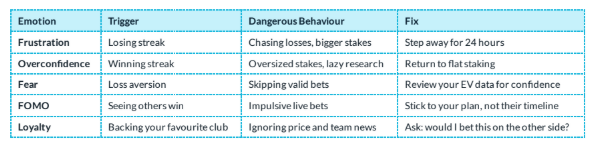
The key isn’t to eliminate emotion – it’s to manage it before it manages you.
3. Building a Pre-Bet Routine
Every professional has a pre-bet process that keeps them grounded. Here’s our version – simple, structured, and effective:
- Pause: Never bet immediately after seeing odds. Take 60 seconds to think.
- Review: Check your bankroll tracker. Is this within your limits?
- Confirm: Do the numbers and logic support this bet?
- Decide: Place it only if you’d be proud to log it in your records.
- Walk Away: Once it’s placed, don’t watch the odds move. The work is done.
This five-step system creates emotional distance – a crucial ingredient in long-term success
4. The Myth of the “Hot Hand”
Everyone believes they’re “on a roll.” But probability doesn’t care about your streak. Your last winning bet doesn’t make the next one more likely.
The same goes for teams. A side on a five-match winning run still has to beat the next XI, at the next venue, in the next conditions. Recent form is data; a streak is not a guarantee – and the best cricket prediction tips treat it that way.
The “hot hand” illusion tricks bettors into upping stakes, skipping research, and losing focus. Smart bettors know that streaks are random, discipline is not.
If you’re winning, stick to your system. If you’re losing, stick to your system.
That’s how professionals survive variance – and amateurs don’t.
5. Resetting After a Loss
Losses will happen – the goal is to respond, not react. After a bad beat:
- – Step away for the day – even if there’s another match today.
- – Log the result and the reasoning.
- – Ask, “Was my logic sound, even if the outcome wasn’t?” If yes – nothing’s broken. If no – learn, adjust, and move forward.
Betting is a marathon of decisions, not a sprint of emotions.
6. Responsible Betting = Smart Betting
Control isn’t just good psychology – it’s good business. Set limits, take breaks, and use tools like deposit caps and timeouts. These aren’t signs of weakness; they’re signs of professionalism.
Reminder: “The strongest bettors aren’t fearless – they’re disciplined.”
If you ever feel betting is controlling you instead of the other way around, pause and reset. Smart money always protects itself first.
7. Key Takeaway
The difference between a gambler and a strategist isn’t knowledge – it’s composure. When you learn to control your emotions, you control your outcomes.
The smartest bettors win before the first ball is bowled – in their mindset.
Chapter 7 – The Smart Cricket Predictor’s Checklist: Your Pre-Game Routine
Smart betting isn’t about guessing right – it’s about preparing right.
Before every match, every ticket, and every stake, professionals run through a short, structured routine that keeps emotion out and precision in. This is your Cricket Pre-Game Checklist – the most practical page in this cricket betting guide.
1. The 6-Step Pre-Bet Routine
Step 1: Research the Match
- – Have you reviewed both teams’ form, head-to-head record and venue history?
- – Did you check the XI and international & overseas availability?
- – Have you accounted for external factors (travel, weather, dew, motivation)?
If you’re betting on opinion, stop. If you’re betting on data, proceed.
Step 2: Analyse the Odds
- – Do you understand what the odds imply (probability and payout)?
- – Have you compared odds across multiple sportsbooks?
- – Is there any sign of market movement (drifting or shortening prices)?
Remember: odds are opinions – find where they’re wrong.
Step 3: Check for Value
- – Based on your research, is the true probability higher than the odds imply?
- – Are you betting on a narrative or on a mispriced market?
No value = no bet. Every professional lives by that rule.
Step 4: Confirm Your Stake
- – Is this bet within your bankroll plan (1–2% of total) and today’s cap?
- – Does it align with your current form and risk tolerance?
- – Will you still feel good about this decision tomorrow?
Betting is business – keep it consistent.
Step 5: Log the Bet
- – Record the stake, odds, market, venue and reasoning in your tracker.
- – Add notes on why you placed it – win or lose, that’s your data goldmine.
- – Set aside a few minutes after each match day to review results.
Your future edge lives in your past data.
Step 6: Detach Emotionally
- – Don’t chase the next bet; you’ve done the work.
- – Let the result happen – you’re in control of process, not outcome.
- – Celebrate logic, not luck.
Professional bettors don’t bet harder – they bet calmer.
2. Bonus: The “Smart Bet” Quick Test
Before confirming your bet, ask yourself these three final questions:
- Can I explain the logic of this bet in one sentence?
- Does the data back my reasoning, not just my gut?
- If I lost this bet, would I still consider it a good decision?
If you can answer yes to all three – it’s a smart bet.
3. Your Match-Day Card
Keep this next to your screen on every match day. If a box stays empty, the bet waits.
Before the toss
- – Venue conditions and boundary size checked
- – Day or night start, weather and dew checked
- – Overseas availability confirmed
- – Prices compared across books
After the toss
- – Both XIs read in full
- – Points-table stakes for both sides noted
- – Stake within today’s cap
- – Bet logged with a one-line reason
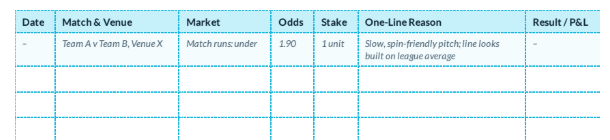
4. Your Bet Tracker Template
Copy this into a notebook or spreadsheet. The first row is an illustrative example.
5. Key Takeaway
Smart betting isn’t complicated – it’s consistent. Whether you’re acting on your own research or on cricket prediction tips, run your checklist, track your results, and stay calm under pressure. That’s the formula that separates emotion from strategy – and gamblers from winners.
The pros have systems. The rest have stories. Be a pro.
Chapter 8 – Responsible Betting & Long-Term Profit
Smart bettors don’t just know when to bet – they know when not to.
Long-term profit in sports betting isn’t built on streaks or luck; it’s built on discipline, structure, and control.
The reality is simple: betting should always stay a choice, never a chase. When it becomes a chase, even the smartest playbook stops working.
You’re not betting to escape – you’re betting to engage, learn, and win intelligently.
1. The Long Game Mindset
The professional bettor’s goal isn’t to “win today” – it’s to stay profitable over time. That means consistency over excitement, patience over adrenaline, and review over reaction. Think like an investor:
- – One good bet doesn’t make you a genius.
- – One bad run doesn’t make you unlucky.
- – Profit is measured in seasons, not matches.
A T20 league season lasts a few weeks. Your betting life lasts far longer. When you play for the long term, every result becomes data – not drama.
2. Set Boundaries Before You Bet
Of all the cricket betting tips in this playbook, this may matter most: boundaries protect you from emotion and keep betting fun, focused, and controlled.
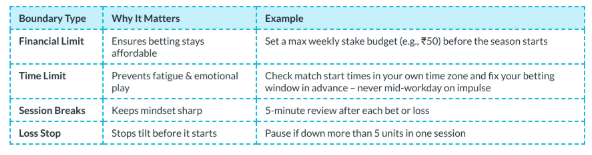
Boundaries are the foundation of professionalism – not restriction, but structure.
Pro Insight: “The smartest bettors don’t rely on willpower – they rely on systems that protect their edge.”
3. Responsible Play = Sustainable Profit
The strongest bettors understand that control is profitability. A calm mind makes better decisions, a managed bankroll lasts longer, and consistent habits turn learning into earning.
Discipline is the only edge that never changes.
Play for the challenge. Play for the data. Play with awareness. Because when you stay in control, you stay in the game.
Key Takeaway
Responsible betting isn’t the opposite of winning – it’s the reason professionals win, and why no cricket betting guide is complete without it. When you control your habits, you control your results.
Smart bettors think long-term. Responsible bettors last long-term.

Conclusion – It’s Time to Play Smart
Across this cricket betting guide, you’ve built the foundations that separate the dreamers from the disciplined – the casual bettors from the professionals.
You understand odds, recognise value, manage your bankroll, and keep your emotions in check. You know how powerplays, playoff formats, venues and conditions shape cricket markets.
That combination doesn’t just make you a better bettor – it makes you a smarter thinker. Because smart betting isn’t about luck. It’s about control, consistency, and confidence.
That’s what knowing how to bet on cricket really means: you’re no longer betting to guess. You’re betting to make good decisions.
The Smart Cricket Predictor’s Mindset
Every winning bettor lives by three simple truths:
- Process beats outcome.
- Discipline beats emotion.
- Longevity beats luck.
The bookmakers don’t fear reckless bettors – they fear informed ones.
And now, you’re one of them.
Final Word from the Team
Our mission with this cricket betting and prediction guide is simple: to help you think sharper, play smarter, and stay in control.
Whether you’re following the action from the stands or on your phone during your lunch break, carry these cricket betting tips with you and remember: your edge isn’t luck – it’s logic.
The smart cricket predictor doesn’t just watch the game – they master it.
Now it’s your turn.
Play smart. Stay disciplined. And bet with purpose.


