
The men’s cricket tournament at Aichi-Nagoya 2026 starts on 24 September, a week after the women’s event has already come and gone. Ten teams, one ground, ten days, and a gold medal decided on 3 October. India arrive as defending champions, having taken both cricket golds at Hangzhou 2023.
That is the single biggest difference between this edition and the last three. Shreyas Iyer leads a squad that is identical to the one India used for their most recent T20I series, and India go in as reigning T20 World Cup winners and the top-ranked side in the format. They warmed up by sweeping Afghanistan 3-0 in Delhi, finishing with a 127-run win on 17 September in which Abhishek Sharma made 108 off 34 balls. Most boards treat the Asian Games as a second-string assignment. India have treated it as a tournament they intend to win.
Format: Preliminary groups, then straight knockout
Teams: 10
Venue: Korogi Sports Park (Korogi Athletic Park), Nisshin, Aichi Prefecture — one ground for every match
Dates: 24 September – 3 October 2026
Match timings (IST): 5:30 AM and 10:30 AM double-headers
Men's Asian Games 2026 at a glance
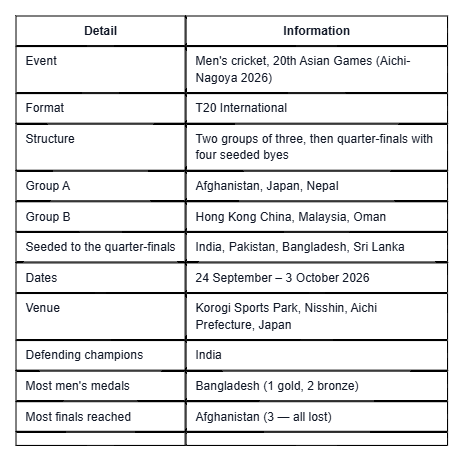
Afghanistan, Japan and Nepal sit in Group A; Hong Kong China, Malaysia and Oman make up Group B. The top two from each group join the four seeded teams in the quarter-finals.
A Quick Look at Asian Games Men's Cricket History
Cricket has never been a permanent resident at the Asian Games. It arrived at Guangzhou 2010, returned at Incheon 2014, was cut from Jakarta 2018 and came back at Hangzhou 2023. Aichi-Nagoya is its fourth outing.
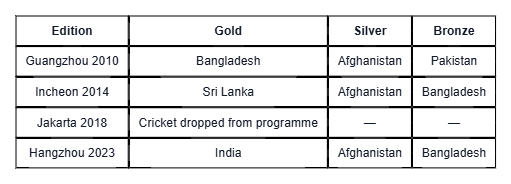
The men’s event has produced three different gold medallists in three attempts — and one permanent runner-up. Bangladesh won the first title in 2010, beating Afghanistan in the final, with Pakistan taking bronze. Four years later Sri Lanka beat Afghanistan in Incheon to win gold, with Bangladesh third. At Hangzhou, the final between India and Afghanistan was washed out after 18.2 overs and India were awarded gold as the higher-seeded side.
Asian Games Men's Cricket Medallists (2010–2023)
What the history actually tells us
- – Afghanistan are the nearly-men of this event. Three appearances, three finals, three silvers. In 2026 they do not even start in the knockouts — they have to come through a group of three first.
- – Weather has decided more medals here than batting has. Two of the last three men’s tournaments had a medal match or a semi-final settled without a full game being played. Anyone following this event closely needs to read the rain regulations before they read the team sheets.
- – Par scores have historically been modest. These are short tournaments on unfamiliar, under-used surfaces, usually played by squads assembled at short notice. Continental finals here have been scrappy rather than explosive.
- – Squad strength is the real variable. The gold medal has tended to go to whoever took the tournament most seriously. That is a useful lens for 2026, because the strength gap between the ten squads on show is unusually wide.
The Ten Teams and how they got here
Japan qualified as hosts, the five Asian Full Members — Afghanistan, Bangladesh, India, Pakistan and Sri Lanka — qualified automatically, and four places came out of the 2026 Asian Games Qualifier in Singapore, won by Nepal ahead of Hong Kong, with Malaysia and Oman also progressing. Seeding was set on the ICC Men’s T20I Team Rankings as of 23 July 2026, with the draw held the same day.
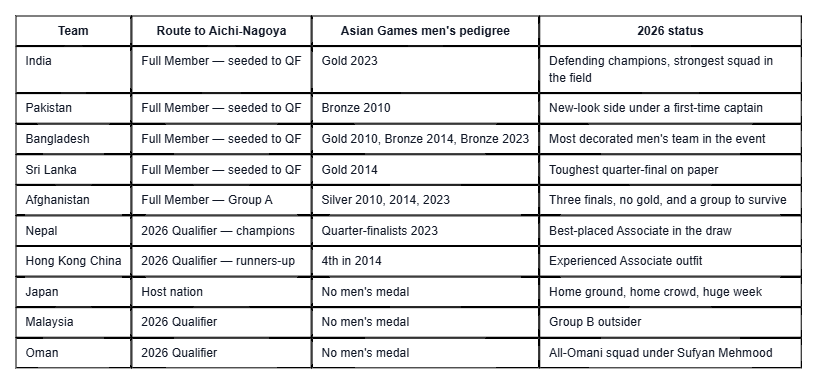
Reading the bracket
Three things fall straight out of the draw.
- – Sri Lanka drew the short straw. Of the four seeded sides, they are the only one who must beat a group winner in the quarter-final — most likely Afghanistan. India, by contrast, meet a group runner-up, which on current form points to Nepal or Japan.
- – India and Pakistan cannot meet before the medal matches. The draw keeps the two apart until the bronze or gold medal game. If you want that fixture, both sides have to win twice first — and 3 October is the only date it can happen.
- – One seeded team is guaranteed to go home in the quarter-finals. Four byes, four quarter-finals, four group qualifiers. The maths does not care about reputations.
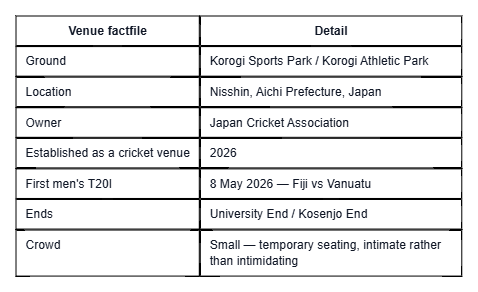
Venue & pitch analysis: korogi sports park, nisshin
Everything at this tournament runs through one small ground on the eastern edge of the Nagoya sprawl, and almost nobody in the field has played there.
What the surface is likely to do
The ground’s first international week came in May 2026, when it hosted East Asia-Pacific qualifying matches — a handful of games between Associate sides, played months before this squad list existed. That is the entire body of evidence
Three practical consequences:
- The women’s tournament was the reconnaissance mission. Six days of cricket on this square finished just before the men arrived. Anyone assessing par scores, new-ball movement and how much the spinners grip should be working off that data rather than off subcontinental instincts.
- Spin is likely to be a wicket-taking option, not just a brake. A fresh square with genuine carry tends to reward bowlers who give the ball a rip. India, Bangladesh, Afghanistan and Nepal all travel with multiple frontline spinners.
- Small ground, short boundaries, big variance. A venue this size flatters clean strikers and punishes anyone who bowls a fraction short. Totals can move quickly in either direction.
Weather watch
This is the tail end of Japan’s typhoon season, and the tournament has already felt it. The opening women’s quarter-final between Bangladesh and China on 17 September was abandoned without a ball bowled after rain left conditions unfit, and Bangladesh advanced on their superior ranking. China’s entire campaign ended without a single delivery, because the knockout playing conditions send the higher-ranked team through when no result is possible.
Read that twice before the men’s knockouts start. The same principle decided the 2023 men’s gold medal. In a tournament with no reserve-day culture, a wet morning in Nisshin is worth more than a batting order!
Players to watch at the Men's Asian Games 2026
Abhishek Sharma (India) — He made 108 off 34 balls against Afghanistan on 17 September, reaching his hundred in 30 deliveries. On a small ground with true bounce, he is the most likely player in the field to end a knockout match inside six overs.
Jasprit Bumrah (India) — The most valuable bowler at the tournament by a distance. India rarely take him to events like this; says plenty about how the BCCI is treating the gold medal.
Vaibhav Sooryavanshi (India) — The leading run-scorer and Player of the Series on India’s tour of Zimbabwe in July. A tournament like this is exactly where a teenage prospect gets a long look.
Sahibzada Farhan (Pakistan) — A 30-year-old opener with more than 1,300 T20I runs, now leading a side for the first time. Pakistan’s ceiling depends almost entirely on how quickly his top order settles.
Saim Ayub (Pakistan) — The one genuinely established match-winner in the Pakistan squad, and the player most likely to make their half of the draw interesting.
Litton Das (Bangladesh) — Captain of the most decorated men’s side in Asian Games history, and the only seeded team here that has medalled in all three previous editions.
Dipendra Singh Airee (Nepal) — Nepal won the Asian Games Qualifier in Singapore, with Kushal Bhurtel finishing as Player of the Series after 340 runs. Nepal beat nobody by accident any more.
Sandeep Lamichhane (Nepal) — Leg spin on a gripping new square, in a format where one good spell flips a knockout tie. The most dangerous Associate bowler in the draw.
Kendel Kadowaki-Fleming (Japan) — Japan’s all-time leading T20I run-scorer, leading the hosts on their own ground. His side also face India in a one-off T20I in Sano on 22 September, the first time a Japan men’s team has played an ICC Full Member.
Chaska Bhai Tips & Predictions
- Treat 24–26 September as free information. Six group games on a square nobody knows, before the big four have played a ball. Par score, powerplay behaviour, whether the ball skids or grips — all of it gets answered by the time the quarter-finals start. Watching the Associates is not filler here, it is research.
- The seeded byes cut both ways. India, Pakistan, Bangladesh and Sri Lanka walk into a knockout without a single competitive hit at the venue, against an opponent who has had three days of it. In 2023 the group teams took that advantage into more than one upset scare. Do not assume the rust is priced in.
- Read the rain rules before you back anyone. A washed-out knockout does not go to a reserve day — it goes to the higher-ranked side. That has already ended one team’s campaign at this venue in 2026, and it decided the last men’s gold medal. Weather is not a footnote in this tournament, it is a tiebreaker.
- Squad depth is the story, not team names. Some of these XIs are first-choice sides; others are development squads carrying a national flag. The gap between India’s bench and Pakistan’s first XI is the single most useful thing to understand before the knockouts.
- Expect lower totals than a small ground suggests. New surface, cool mornings, humidity, spin-heavy attacks and knockout nerves. Until the group stage says otherwise, treat 150 as a competitive first-innings score rather than a starting point.
Dark horses to watch
Nepal and Afghanistan. Nepal won the qualifier, have a settled leadership group and carry a genuine wicket-taker in Lamichhane — and if they top Group A they land Sri Lanka rather than India. Afghanistan are the other one: even a second-string Afghan side has more T20 common sense than most teams in this field, and they have reached every single final so far.
Predicted Finalists
India and Pakistan. They are in opposite halves, and both have a route that avoids the other until 3 October. Bangladesh are the likeliest side to spoil it, with Sri Lanka handicapped by the toughest quarter-final draw of the four seeds.
Predicted Gold Medallist
India are the strongest contenders for gold at the Men’s Asian Games 2026. They are the reigning T20 world champions, they have named an essentially first-choice squad rather than a development group, they arrive on the back of a 3-0 sweep with their openers in ferocious touch, and they have Bumrah for the two matches that matter. The obvious counter is that a single knockout defeat ends it — which is precisely why this is a prediction and not a promise.
Final Takeaway for Fans & Bettors
The Men’s Asian Games 2026 is ten teams, one small new ground, and a format that gives nobody a second chance after 26 September. India are the correct favourites by some distance, but a knockout tournament on an unfamiliar surface in typhoon season compresses the gap between the best side and the fourth-best side more than any league ever will.
Watch the group stage properly, respect what the pitch tells you in the first three days, and keep one eye on the forecast. At this event, that has historically mattered as much as the team sheet.


